I almost fainted walking downstairs.That should probably have been the moment I accepted something was seriously wrong. It wasn’t. I was 21, and people like me didn’t get chronically ill. I trained two or three times a day because I loved it, not because I had to. I cycled everywhere. I played hockey at a competitive level, climbed rocks for fun, ran, surfed, and if a festival, a flight, or a weekend away came up, my answer was already yes before anyone finished asking. My calendar looked like three people’s lives squeezed into one, and I wouldn’t have had it any other way.
So when I caught what was almost certainly COVID-19 on 16 April 2020, back when tests barely existed and half of Britain assumed it was a bad flu. I did what I’d always done when life got difficult. I pushed through it.
It took me five years to learn why that was the worst possible strategy.
Who I was before
I’ve never been someone who does things by halves. I studied Industrial Design and Technology, and built a career I’m genuinely proud of — starting in the R&D labs at Procter & Gamble, then moving into a high-pressure medical design agency, where I spent my days translating complex engineering problems into products that improve, and sometimes save, people’s lives. Along the way I picked up two Red Dot Design Awards and a reputation as the “bilingual bridge” on projects where technical jargon usually gets in the way of progress — fluent in English and Dutch, and just as fluent in translating “engineer” into “board-level stakeholder.”
Outside work wasn’t any quieter. I played hockey for Loughborough University and later in Dublin’s top leagues. Gym sessions before and after work. Climbing at weekends. Cycling everywhere because why would I take the bus. Friends used to joke that my diary looked exhausting. I secretly agreed, and I loved every minute of it.
I tell you this not to boast, but because it matters for what comes next. Long COVID doesn’t just take your health. For people like me, it takes the identity you built your whole life around — the woman who never sat still, who believed that if something was worth doing, it was worth throwing everything at.
When my body first said no
For the first fortnight I was properly ill — bed-bound, barely able to make it to the bathroom without the room tilting, losing weight and colour so fast that my family told me afterwards I’d gone grey. I’d never been a person who got seriously ill, and that was the first moment I understood something was badly wrong.
As soon as I could stand, I went straight back to normal. Back to work before I was ready. Powering through the fatigue because powering through was the only gear I had. I held together, just about, until I returned to university to finish my degree and came down with shingles. That was the moment I couldn’t out-work it any longer. I made the decision to split my final year across two years instead of one.
At the time it felt like failure — the first time in my life I hadn’t found a way to just get it done. Looking back, it was the first time my body forced me to listen. I just wasn’t ready to hear it yet.
Five years of an invisible illness
What followed was five years of symptoms that shifted, multiplied, and occasionally disappeared before circling back. Crushing fatigue that felt like a weighted blanket thrown over every muscle, making the simplest movement cost twice what it should. Brain fog that turned remembering a conversation into hard labour. Dizziness, POTS, a racing heart on the stairs, breathlessness and chest pain that all arrived together, gut problems, poor temperature regulation, sleep that wouldn’t come until the moment I finally had to be up. An irregular heartbeat I’m still investigating today.
But the symptom that took the most from me was migraines. Before COVID I couldn’t tell you what a headache felt like. Afterwards, they became the metronome of my life — good days and migraine days, on a loop I couldn’t predict or control.
The cruel part of a chronic illness like this is that it’s mostly invisible. I kept working, because it was the one area I refused to let slip. I kept saying yes to plans, because seeing friends was the only thing that made me forget I was ill — even knowing I’d spend the following two or three days paying for it. I kept playing hockey, chasing a level of fitness my body could no longer sustain, able to perform in preseason to September and unable to recover between sessions by November. I wasn’t competing against the opposition any more. I was competing against myself, and mostly losing.
People saw the version of me that turned up. They didn’t see the crash that came after.
The search for answers
Getting a diagnosis took time — understandably, given the NHS was busy fighting a pandemic rather than chasing people who technically hadn’t died of it. I wasn’t formally seen for Long COVID until early 2021. What followed was years of being handed between specialists: cardiology, respiratory, neurology, ENT, Long COVID clinics, Long COVID physiotherapy. MRIs, blood tests, ECGs, lung function tests, tilt-table tests. Each department looked carefully at their one piece of the puzzle. Nobody was looking at the whole picture — that job fell to me, which is a genuinely difficult ask when brain fog makes it hard to remember what the last consultant even said.
Alongside the NHS, I tried almost everything going: breathwork, acupuncture, therapy, physiotherapy, amatsu, lymphatic drainage, naturopathy, Chinese medicine, meditation, Botox, steroid injections, pacing, diet changes, symptom tracking, wearables. I don’t think there’s one thing that fixed me, and I’m suspicious of anyone who claims there is — humans are too complicated for a single-cause, single-cure illness like this. I believed recovery would come from enough small things stacked on top of each other. So I kept trying things, not out of desperation, but because I never stopped believing there was another step worth taking and emotions are high because of the pain your in.
The decision that changed everything
The real turning point in my recovery wasn’t a treatment at all. It was a decision.
After three years living and working in Dublin, I kept talking to friends about the next big move — New York, a new industry, my own business. More than once, someone would gently ask how exactly I planned to do that while this unwell. I didn’t have an answer, because deep down I already knew one. I wasn’t well. I’d just become extremely good at pretending, even if the façade did sometimes slip.
So, in July 2025 I quit my job, packed up my life in Dublin, and moved back home to London to focus entirely on getting better. It was one of the hardest decisions I’ve made — and, in hindsight, the best one.
Ironically, I got worse before I got better. It’s a bit like finally going on holiday after months of running on empty, and your body waits until the plane lands to fall apart. After five years of quietly holding everything together, mine finally felt safe enough to show me exactly how exhausted it was. It was frightening. It was also the first time in my entire life that I’d actually, properly stopped — and it taught me something that sounds obvious now but felt impossible for years: rest wasn’t giving up. Rest was treatment.
Finding Biowell
At the start of 2026, a good friend of mine — whose devotion to rugby borders on the religious — sent me an article about former rugby player Scrivs, and how the recovery protocol he’d used was now helping current England players. I’d heard of hyperbaric oxygen therapy before, from a friend with Lyme’s disease and from a friend we later lost to the worst effects of Long COVID, both of whom swore by it. For whatever reason, this time the timing was right. I recognised something of myself in Scrivs’ story — an athlete, stubborn, determined to get back to a life they loved. I booked a consultation.
I’m a natural sceptic, and I’ve come to believe that’s not a bad thing, I like to question the science behind all the treatments I try. Saying that I am very aware of the placebo effect and if you don’t think something can work, it won’t get the chance to. What struck me from the first conversation with the Biowell team was how genuinely invested they were in me getting better. Real recovery stories are rare in the Long COVID world, where it’s easy to feel like you’re the only person going through it. Hearing Scrivs’ story, and then having a team who clearly believed in mine, gave me something I hadn’t had in years: a plan, backed by both people and evidence, that I actually wanted to try.
The original protocol
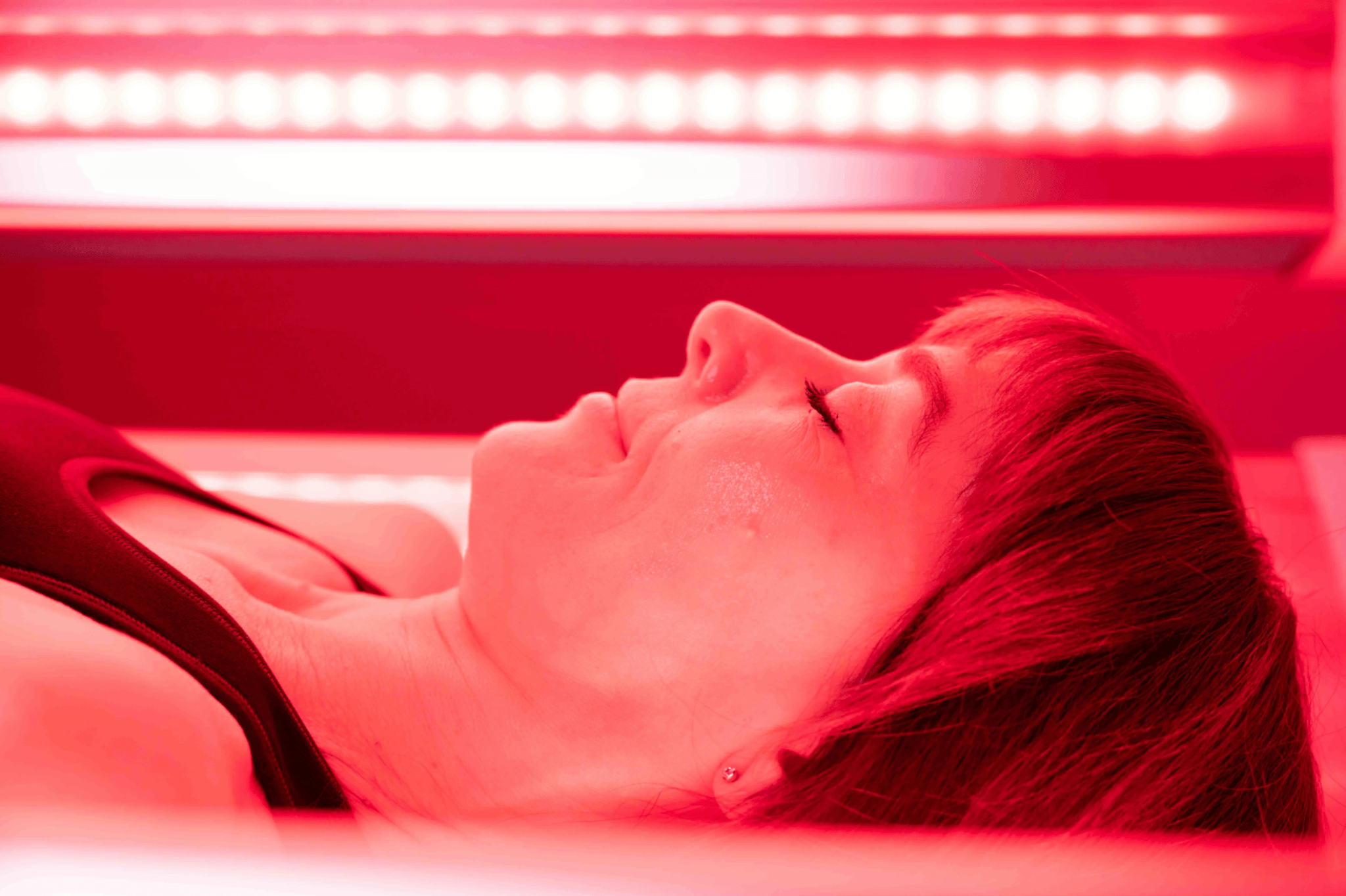
I started on a combination of Hyperbaric Oxygen Therapy, PEMF, compression therapy, cryotherapy, red light therapy, and occasional NAD+ IV drips, coming in three times a week for around two months.
The first few weeks were tougher than I expected — not the flattening exhaustion I knew from Long COVID, but something closer to the good kind of tired after a long day of sport. I needed a lot of rest around the sessions, but I could feel my body handling more each week, even noticing how the settings I could tolerate shifted with my menstrual cycle.
Then the changes became impossible to ignore. More energy. Clearer thinking. My migraines didn’t disappear, but they became far less frequent and far less severe — and given how low my baseline was, that alone was enormous. I started noticing things the team could see too: more colour, more energy in how I held myself, more of my old bubbly self showing up without me having to fake it. I got to a point where I could sit at a computer and write for hours, something that would have been unthinkable a few months earlier.
Reassessment, and a new protocol
Once the initial treatment phase had done its job, my programme moved into a maintenance phase, built in consultation with the team to keep challenging my body rather than just holding steady. Today I’m on PEMF, IHHT and red light therapy. IHHT is more demanding on the body than the rest, but the theory — flushing out the cells with the poorest-performing mitochondria to make room for healthier ones — has borne out in how I’ve continued to improve since.
I like data, and the data backs up what I feel. My resting heart rate has dropped by around ten beats per minute. My heart rate variability has improved by a similar margin. Both track exactly with what my life looks like now.
What else helped
Biowell was a part of the story. Therapy has helped enormously to work on the mental side of things, unpicking old beliefs I didn’t even realise I was carrying and still slightly carry — including the quiet, corrosive idea that a flare-up was somehow my fault, that I must have done too much. I was fortunate enough to take part in the Balance ACT clinical trial at King’s College London, and I’m now on a second King’s trial looking at breathlessness and cardiovascular function. The first trial taught me things about the mind-body relationship I’d never encountered before, and it delivered an unexpected confidence boost too: out of nearly 200 participants, I turned out to be one of the physically strongest. Long COVID hadn’t taken my strength away. It had just changed how reliably I could access it.
Naturopathy, gut support, and time in NHS Long COVID support groups rounded out the picture — the groups in particular were a strange mix of comforting (finally, people who understood) and challenging (finding myself, more than once, cast as the most positive voice in the room on days I didn’t feel very positive at all).
Where I am now
Recovery hasn’t been a straight line, and I don’t think it ever is with a chronic illness. I still have flare-ups. Some days still knock me flat. But on my good days, I’d put myself at around 80% recovered — a sentence I could not have written two years ago.
Today I’m back in the gym. I’m running. I’m playing football in a league again. I’m socialising properly for the first time in years, dating, job-hunting, able to sit down and write out six years of my own story without it costing me the rest of the week. None of that felt possible before Biowell. Now it’s just my life again.
What Long COVID taught me
If there’s one thing this illness has taught me, it’s compassion — for other people living with things nobody else can see, and, harder still, for myself.
I’ve learnt that ambition isn’t measured by how busy you are, that rest isn’t the opposite of achievement, and that a setback doesn’t erase the progress before it — it just means your body is still doing the work of healing.
I’m still the same driven, stubborn and hardworking person I’ve always been. I still want to build things, solve hard problems, and say yes to adventure. The difference is that I no longer measure a good life by how full my calendar is. I measure it by how well I am, and by whether I’ve got the energy left over to actually enjoy the things I say yes to.
If you’re reading this in the middle of your own Long COVID story and it feels endless, I want you to know two things. The pain is real, there’s no getting around that and I empathise enormously with that pain. But there are people who want to help you, treatments worth exploring, and a way through — even if, like me, it takes a lot longer and a lot more trial and error than you’d like, there is always something to learn from each ‘mistake’ or ‘set-back’ and I would not be who I am today without all of those lessons.
I don’t know exactly where I’ll be in a year. Back in design engineering, maybe. Building something of my own. Living abroad again. For the first time in six years, thinking about that doesn’t seem unrealistic to me.
It genuinely excites me.

Check out the Long Covid package here:
This package brings together our unique long covid protocol that has been developed following numerous case studies lead by one of our co-founders.
This package provides the Biowell long covid protocol of 5 therapies delivered in combination in each visit and which should be received 3-4 times a week over a 4-6 week period. The therpies included are: