

Under Pressure: What ATA Really Means in Hyperbaric Oxygen Therapy
It's the quiet little acronym on every HBOT menu, and the key to understanding what's actually happening inside the chamber. Here's your need-to-know.
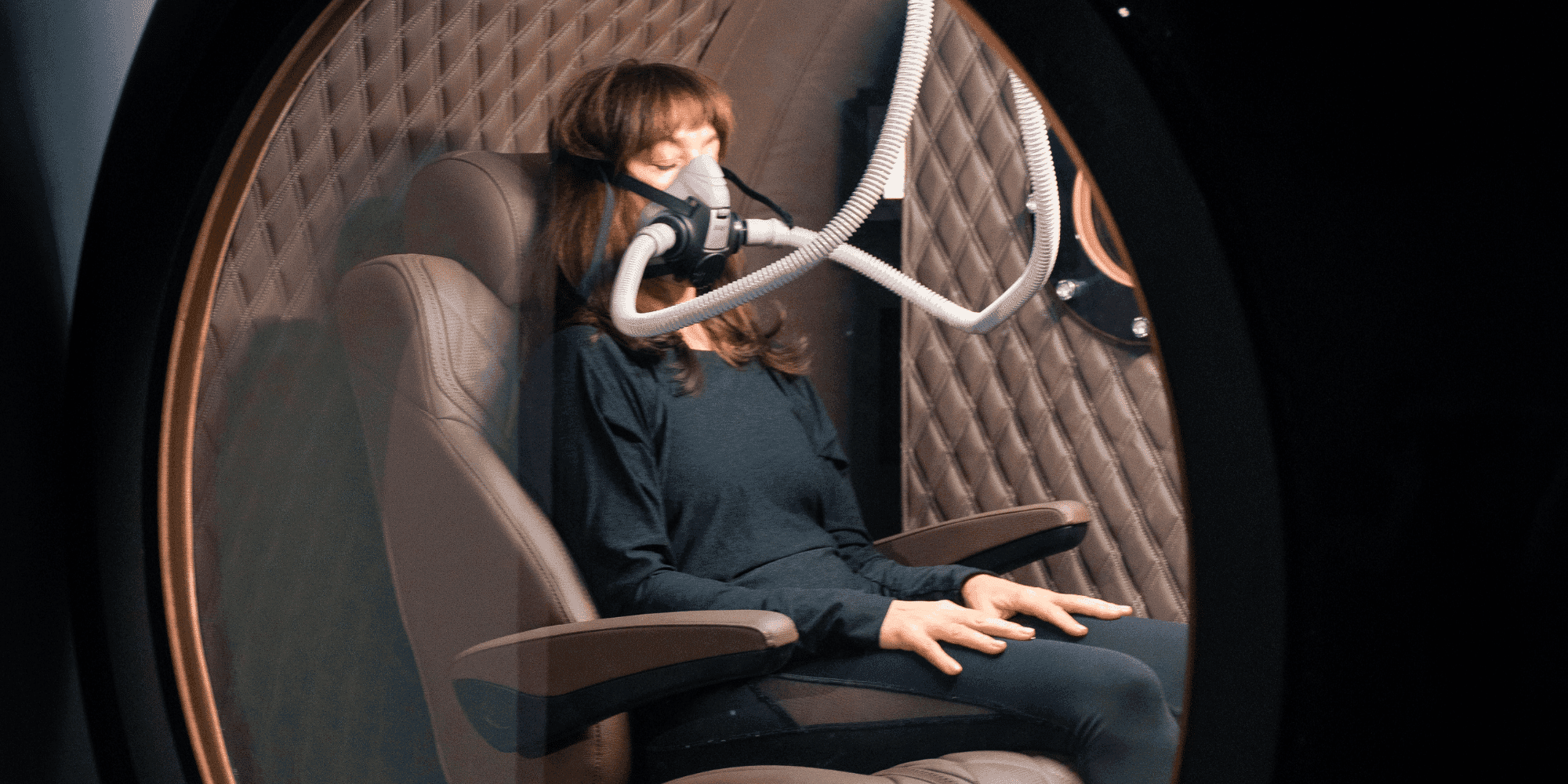
If you've spent any time in wellness circles lately, you'll have heard hyperbaric oxygen therapy spoken of in reverent tones. Elite athletes swear by it for recovery, longevity devotees fold it into their weekly rituals, and it has quietly become one of the most talked-about treatments of the moment.
But look closely at any HBOT menu and you'll notice three letters that rarely get explained: ATA. It's the detail that tells you what a session actually involves, so it's worth getting fluent in.
First things first: what does ATA stand for?
ATA means atmospheres absolute, the unit used to measure the total pressure around your body. Right now, reading this (assuming you're not on a mountaintop), you're sitting at 1 ATA: the natural weight of the air at sea level, roughly 14.7 pounds pressing on every square inch of you. You don't notice it because you've lived in it your whole life. Inside a hyperbaric chamber, that pressure is gently increased. A session at 2.0 ATA means you're experiencing twice the atmospheric pressure of everyday life.
The "absolute" matters. Unlike the gauge on a bicycle pump, which only reads pressure above normal air, ATA counts everything, including the atmosphere you started with. That's why 1.3 ATA doesn't mean "1.3 units of extra pressure"; it means 30% more than sea level.
The diver's shortcut
The easiest way to picture ATA is underwater. Every 10 metres of seawater adds roughly one atmosphere of pressure, so: • 1.3 ATA is like being about 3 metres down, the bottom of a deep swimming pool • 1.5 ATA is around 5 metres • 2.0 ATA is around 10 metres, a comfortable recreational dive
Except, of course, you're dry, reclining, and probably halfway through a podcast.
Why pressure changes everything
Normally, oxygen travels through your body hitched to haemoglobin in your red blood cells. The catch is that in a healthy person those cells are already almost fully loaded. Breathe more oxygen at normal pressure and there's very little extra room. Add pressure and the rules change. Thanks to a principle called Henry's Law (the same physics that keeps the bubbles dissolved in a sealed bottle of champagne), gas dissolves more readily into liquid under pressure. In the chamber, oxygen starts dissolving directly into your blood plasma, the fluid part of your blood, rather than relying solely on red blood cells for the ride.
That dissolved oxygen can travel further and reach tissues that ordinarily get less of it. Pressure plus concentrated oxygen is the combination that makes HBOT what it is. One without the other simply isn't the same treatment. Pressure is the part people overlook. An oxygen mask on its own can't recreate what happens inside a pressurised chamber.
Soft chambers vs hard chambers: the great divide
Not all chambers are created equal, and ATA is the clearest way to tell them apart. Soft (or "mild") chambers are the inflatable, fabric-shelled units you may have seen marketed for home use. They typically top out at 1.3 to 1.5 ATA, and many simply pressurise ordinary air, which is around 21% oxygen. Hard chambers are rigid vessels built to hold higher, more precisely controlled pressures, and they can deliver concentrated oxygen via a mask or hood. The very highest pressures, up to 3.0 ATA, are reserved for hospitals treating specific medical conditions.
At Biowell, sessions take place in medical-grade, hard-shell chambers at 2.0 ATA, where you breathe 90–95% pure oxygen through a comfortable adjustable mask, a combination a soft chamber simply can't match.
So is higher always better?
In a word: no. And this is the bit the wellness world often gets wrong.
Pressure works more like a dose than a dial you turn up for extra results. Beyond a certain point, more pressure brings more risk, such as ear and sinus strain or, at the high end, oxygen toxicity, without a matching rise in benefit. That's why hospital protocols are carefully calibrated to specific conditions rather than pushed to whatever the chamber can manage. There's also a growing field of research into what's known as the hyperoxic-hypoxic paradox: the idea that repeated, moderate exposures may prompt the body to respond in beneficial ways, including supporting new blood-vessel growth. The science is still developing, but it points to a more nuanced truth: the right pressure, repeated consistently, matters more than the biggest number.
What does it actually feel like?
Reassuringly ordinary. As the chamber pressurises, you'll notice a fullness in your ears, very much like the descent on a plane. Swallowing, yawning or gently equalising clears it. Once you reach pressure, the sensation settles and most people simply relax, read or nap.
At Biowell, a member of the team is on hand throughout. If anything feels uncomfortable, the pressure can be eased, raised more slowly, or the session paused altogether.
Your ATA cheat sheet
• 1.0 ATA: everyday life at sea level • 1.3–1.5 ATA: mild, soft-chamber territory • 2.0 ATA: Biowell's medical-grade, hard-shell chamber sessions • Above 2.0 ATA, up to 3.0 ATA: hospital only.
Before you book
HBOT isn't for everyone. A history of collapsed lung (pneumothorax), epilepsy, pregnancy, certain ear and sinus conditions, recent surgery and some medications can make pressurisation unsuitable, which is why a proper consultation comes first. HBOT at Biowell is a wellness service and is not a treatment for any medical condition. If you have an existing medical condition, speak to your GP before booking.
The takeaway
ATA is the most important number in hyperbaric therapy, and now you know how to read it. Next time you see it on a menu, you'll know exactly what's being promised, and what questions to ask. Ready to experience it for yourself? Book a 30, 60 or 90-minute HBOT session at Biowell Health, Battersea Power Station.
Wondering how this applies to you?
A consultation is where we work out which of this is actually relevant.
Related goal
Where this fits
The goal this article sits under, if you would rather start from the outcome.
Brain health
Brain fog, poor focus and mental fatigue usually have physical contributors. We look for the ones we can influence.
- 8 to 12 weeks
- From £95 per session

Immunity
A defence-first approach to feeling well more often: supporting the body's natural immune response before illness takes hold, not just treating it once it does.
- Ongoing / monthly
- From £55 per session

Healthy ageing
Healthy ageing is less about adding years and more about keeping the things you can do now — mobility, energy, clarity and recovery.
- 12 weeks
- From £95 per session

Long Covid
A structured, multi-therapy approach for the fatigue, breathlessness and fog that can linger long after the infection itself has cleared.
- From £ TBC per session
- Consultation
Start with a conversation
A consultation is the honest starting point. We will tell you what is likely to help and what is not worth your money.
Get the Biowell app